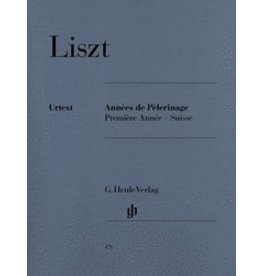
In 1835/1836 Liszt was staying in Switzerland with his mistress Marie Comtesse d'Agoult. He published his bold, avant-garde musical portrayal of his travels in the Swiss mountains in 1842 under the title Albu
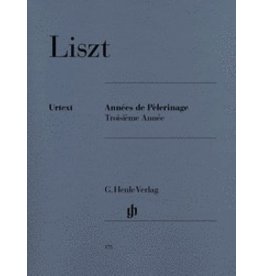
In 1883 the third volume of Années de Pèlerinage was published. Whereas the pieces in Volumes I and II were recollections of early travels in Switzerland and Italy, the new works, composed between 1867 and 18
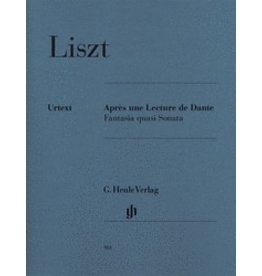
Often referred to as the “Dante Sonata,” this single-movement sonata is based on the Canto “Inferno” in Dante's poem, which depicts the soul's descent into hell. Now available as a single Urtext edition.
Composer: Franz LisztEditor: Ernst-Günter Heinemann
An expressive piano work drawn from the cycle Harmonies poétiques et religieuses, which was inspired by religious-philosophical poems of the French Romantic Alphonse de Lamartine. Includes Liszt's fing
Composer: Franz LisztEditor: Ernst-Günter Heinemann
Liszt's Funérailles is a broadly conceived, virtuoso funeral march that has found a permanent place in the repertoire of all great pianists while remaining within the reach of talented amateurs. This s
Composer: Franz LisztEditor: Ernst-Günter Heinemann
UPC: 884088177591
Publisher Code: HN639
Song List:
Liszt: Andante lagrimoso
Liszt: Appendix: Pensše des morts (first version)
Liszt: Ave Maria
Liszt: Bšnšdiction de Dieu dans la solitude
Liszt: Cantiqu
This work, in which Liszt draws on five different folk themes, is surely one of his most ingenious Hungarian Rhapsodies. It offers a unique mix of melancholy, glittering keyboard acrobatics and stormy, rousin
The Rákóczi march is often referred to as the “Hungarian Marseillaise”. The beginnings of this march song go back to around 1730. In the text, the Hungarians summon Franz II Rákóczi to free his people from th
We have begun with numbers 2 and 6: in the coming years we will be producing editions of all of Franz Liszt's “Hungarian Rhapsodies,” brilliant pianistic excesses and a favourite with all virtuosos. Hungarian
We have begun with numbers 2 and 6: in the coming years we will be producing editions of all of Franz Liszt's “Hungarian Rhapsodies,” brilliant pianistic excesses and a favourite with all virtuosos. Hungarian
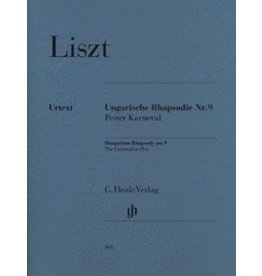
Liszt's ninth Rhapsody is the “Carnival at Pest,” one of the few Hungarian Rhapsodies to which he gave a name. Once again Liszt turns to Hungarian folk melodies and fuses them with improvisatory elements. The
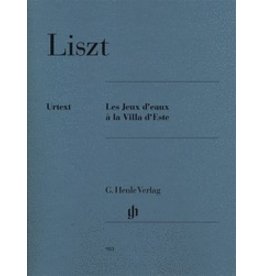
Liszt was a frequent guest of the acting cardinal at the Villa d'Este in Italy. His “Jeux d'eaux” describe the glittering fountains at the cardinal's villa and include a quotation from the Bible, giving the w
Composer: Franz LisztEditor: Ernst-Günter Heinemann
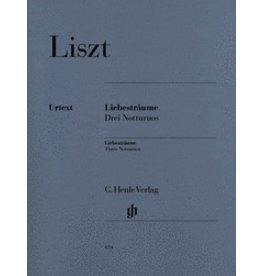
These Drei Notturnos appeared in 1850 in two different versions: the first for high voice and piano and the second for piano solo. In the latter version the music is preceded by the song texts (no. I H
Composer: Franz LisztEditors: Norbert Gertsch, Veronika Giglberger
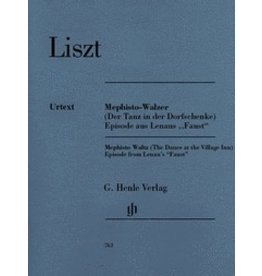
Liszt's Mephisto Waltz is considered by many to be the quintessential bravura piece. Appendix includes a version of the piece that was abridged and simplified by Liszt, available in prin
Composer: Franz LisztEditors: Marc-André Hamelin, Ernst Herttrich
Following the revision of Henle's facsimile of the Piano Sonata in B minor (51483227) in 2015, they now present the corresponding new Urtext edition. With the help of the splendid facsimi
Composer: Franz LisztEditor: Ernst-Günter Heinemann
First published in 1859. This Urtext edition comprises the second version (1872), includes an appendix with ossia version of bars 130-166, and a detailed preface on the changes between first and second
Composer: Franz LisztEditor: Ernst-Günter Heinemann
A six-month tour through Spain and Portugal left its mark ... Fascinated by the temperamental melodies of the Iberian peninsula, Liszt integrated elements of this music into his piano works. The charac
In the second volume, Italie, published in 1858, of the three-part Années de pèlerinage the great names of Italian art and poetry occupy centre stage. Among these was also Petrarch and his collection of sonnets
Over five hundred years after their creation, Liszt set Petrarch's sonnets nos. 47, 104 and 123 to music, creating lyrical and poetic songs for piano. The popular second sonnet no. 104 is available here as a
Composer: Franz LisztEditor: Ernst-Günter Heinemann
Liszt's Transcendental Studies of 1852 are without doubt among the triumphs of virtuoso piano music, and their visionary language and poetic expression make them a milestone of the romantic age. This s