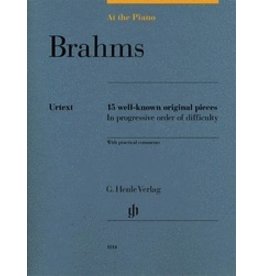
When his contemporaries heard the works that Johannes Brahms had composed during his summer holiday in Ischl in 1893 - the Piano Pieces op. 118 -, they were delighted. Clara Schumann was one of the first to
Johannes Brahms' piano sonatas were among the 20-year-old composer's first publications. They were written in 1852-53, with the slow movement of this C major Sonata, which used the song “Verstohlen geht der Mond auf,” bearing the earliest date, April 1852
Johannes Brahms' summer sojourn in 1893 in Bad Ischl was productive. Alongside the pieces op. 118, he also wrote his last cycle of piano pieces, opus 119. The composer wrote to Clara Schumann of the opening
Brahms mainly composed the eight Piano Pieces op. 76 in summer 1878 in the summer resort of Pörtschach at Lake Wörth. Theodor Billroth, a close friend, was enthusiastic about the new works: “These are magnifi
Composer: Johannes Brahms
Johannes Brahms's piano sonatas opp. 1, 2 and 5 were among the first works that the then 20-year-old composer published. Much of themusic of the f-minor Sonata is closely connected to Brahms's visit to Robert and Clara Schumann
Song List:
Brahms: Ballad B major op. 10,4
Brahms: Ballad D major op. 10,2
Brahms: Ballad [Edward-Ballad] d minor op. 10,1
Brahms: Ballad [Intermezzo] b minor op. 10,
Song List:
Brahms: Ballad B major op. 10,4
Brahms: Ballad D major op. 10,2
Brahms: Ballad [Edward-Ballad] d minor op. 10,1
Brahms: Ballad [Intermezzo] b minor op. 10,
Brahms's First String Sextet became very popular after its publication in 1861, yet his publisher Simrock still hesitated when the composer offered him a second such work in 1865, “in the same cheerful mood”
Composer: Johannes BrahmsArranger: Johannes Brahms
Editors: Andreas Groethuysen, Robert Pascall
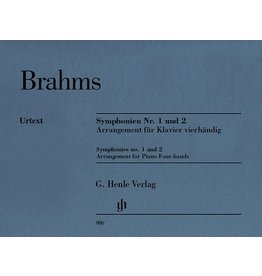
In order to also promote the circulation of his works outside the concert hall, Johannes Brahms made piano arrangements of many of his orchestral works. As t
Brahms' creative arrangements of his Symphonies Nos. 1 and 2 in a new Urtext edition. The scholarly musical text follows the recently published volume in the Brahms Complete Edition.
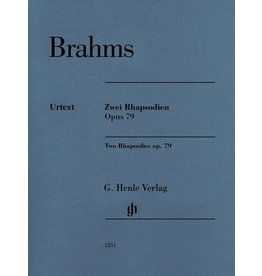
In 1879, about ten years before Johannes Brahms composed his late, melancholic piano pieces, he wrote the two Rhapsodies op. 79 – two markedly passionate and comparatively extensiv
Composer: Johannes Brahms
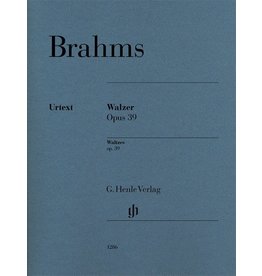
“Do you love Brahms?” The majority of music lovers will answer “yes”, and they might be thinking of the Waltz op. 39 no. 15 its gently rocking melody is one of Brahmss most famous inspirations. Both original versions of this po
Following the publication of the 16 Waltzes for piano four hands, Brahms' publisher succeeded in persuading the composer to do a version for piano solo. After initially hesitating, Brahms suggested two versio
In spring 1865 Brahms surprised his friends and acquaintances with 16 little waltzes for piano four-hands. He informed his friend the well-known critic Eduard Hanslick about this in April 1866, saying that his thoughts while w
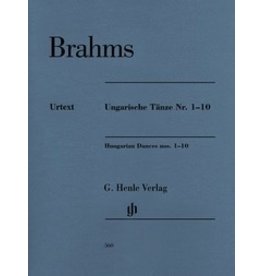
“No opus number” is what Brahms gave his astonished publisher to understand, when he offered him the Hungarian Dances for publication in 1869. He placed a great deal of importance on the fact that he had mere
Brahms' Hungarian Dances count on brilliant and spirited virtuosity whereas his 16 Waltzes op. 39 are more modest and intimate. Yet they are just as haunting - who isn't familiar with the gently rocking melod
Composer: Johannes BrahmsEditor: Sylvia Hewig-Tröscher
Contents: Waltz in E Major, Op. 39, No. 5 • Waltz in B-flat Major, Op. 39, No. 8 • Waltz in D minor, Op. 39, No. 9 • Waltz in G Major, Op. 39, No. 10 • Waltz in B minor, Op. 39, No. 11 • Waltz in A