Comp: Johannes Brahms
Ed: Carl Seemann and Kurt Stephenson
“In this new edition of Johannes Brahms’ Piano Works the results of scholarly research into authentic sources of revision have been combined with the experience of international concert practi
Internationally renowned concert pianist Joseph Banowetz presents this definitive collection of original masterworks by Johannes Brahms, featuring a comprehensive preface, composer biography, vintage photographs, and
Composer: Johannes BrahmsEditors: Andreas Boyde, Katrin Eich
The three popular Intermezzi op. 117 can be seen as the epitome of Brahms' late work for piano. Clara Schumann confessed: “In these pieces I at last feel musical life stir once again in my s
Comp: Johannes BrahmsEd: Carl Seemann
Arr: Kurt Stephenson
“In this new edition of Johannes Brahms’ Piano Works the results of scholarly research into authentic sources of revision have been combined with the experience of international concert pract
Teaching the piano was an important source of income for Brahms, as it was for many nineteenth-century composers. This gave rise to collections of exercises which at first he only occasionally wrote down, but
The Scottish ballad “Edward” from J. G. Herders anthology of folk songs “Stimmen der Völker in Liedern” made such a deep impression on Brahms that, as he told a friend, the melodies came to him effortlessly.
Johannes Brahms presumably wrote the Fantasies Op. 116 at the same time as the Intermezzi Op. 117 in the summer of 1892 in Bad Ischl. His sojourn in the Salzkammergut obviously inspired Brahms to write music
Song List:
Brahms: Capriccio d minor op. 116,1
Brahms: Capriccio d minor op. 116,7
Brahms: Capriccio g minor op. 116,3
Brahms: Intermezzo a minor op. 116,2
Brahms:
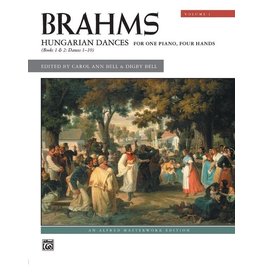
By Johannes Brahms / ed. Carol Bell and Digby Bell
Brahms brilliantly captured the spontaneity and passion of Hungarian gypsy music in his 21 Hungarian Dances. In this volume containing the first 10 dances, editors Carol Ann Bell and Digby Bell have sc
When his contemporaries heard the works that Johannes Brahms had composed during his summer holiday in Ischl in 1893 - the Piano Pieces op. 118 -, they were delighted. Clara Schumann was one of the first to
Johannes Brahms' piano sonatas were among the 20-year-old composer's first publications. They were written in 1852-53, with the slow movement of this C major Sonata, which used the song “Verstohlen geht der Mond auf,” bearing the earliest date, April 1852
Comp: Johannes BrahmsEd: Paul Badura-Skoda and Johannes Gerdes
The gestation period of Brahms' first concerto for piano lasted for over seventeen years. Now of course an integral and permanent part of the repertory, surprisingly it did not find initial f
Composer: Johannes BrahmsEditors: Johannes Behr, Johannes Umbreit, Lars Vogt
Shortly after a rather unsuccessful performance of his Piano Concerto No. 1, Johannes Brahms wrote to Joseph Joachim in 1859: “... a second one will sound different.” Neverthele
Johannes Brahms' summer sojourn in 1893 in Bad Ischl was productive. Alongside the pieces op. 118, he also wrote his last cycle of piano pieces, opus 119. The composer wrote to Clara Schumann of the opening
Brahms mainly composed the eight Piano Pieces op. 76 in summer 1878 in the summer resort of Pörtschach at Lake Wörth. Theodor Billroth, a close friend, was enthusiastic about the new works: “These are magnifi
Composer: Johannes Brahms
Johannes Brahms's piano sonatas opp. 1, 2 and 5 were among the first works that the then 20-year-old composer published. Much of themusic of the f-minor Sonata is closely connected to Brahms's visit to Robert and Clara Schumann
Composer: Johannes Brahms
Johannes Brahms' Piano Sonatas, Op. 1, 2 and 5 were among the first works that the 20-year-old composer published. They were composed in 1852/53, although this “Sonata in F-sharp minor” was apparently the first of the three to
By: Johannes Brahms
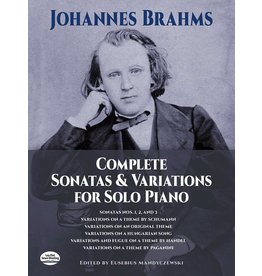
The most ambitious in scale of Brahms's pieces for piano solo, the sonatas and variations, are contained complete within this volume: the three beautifully lyrical Sonatas in C Major, F-sharp Minor and F Minor, and the five sets of Var