In the second volume, “Italie”, of the three-part “Années de pèlerinage”, which was released in 1858, the great names of Italian art and poetry take centre stage. This also includes Dante with his famous “Divin
Composer: Franz LisztEditor: Ernst-Günter Heinemann
An expressive piano work drawn from the cycle Harmonies poétiques et religieuses, which was inspired by religious-philosophical poems of the French Romantic Alphonse de Lamartine. Includes Liszt's fing
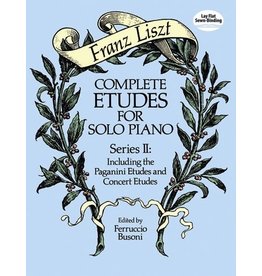
By: Franz Liszt, Ferruccio Busoni
Liszt's reputation as perhaps the greatest pianist of all time is powerfully supported by his dazzling body of work for solo piano. The undiminished popularity of his etudes with pianists and audiences alike have made the
By: Franz Liszt, Ferruccio Busoni
Liszt's reputation as perhaps the greatest pianist of all time is powerfully supported by his dazzling body of work for solo piano. The undiminished popularity of his etudes with pianists and audiences alike have made the
Publisher: G. Schirmer, Inc.Artist: Alexandre Dossin
Composer: Franz Liszt
Editor: Alexandre Dossin
Liszt made significant contributions to piano literature. Consolations and Liebesträume were first published in 1850 and have become Liszt's most approach
By Franz Liszt
The New Liszt Edition in Series I and Series II published the final versions of all Liszt piano solo works, original and arrangements. The Supplement Series presents earlier and alternate editions of Liszt piano solo works, and Volume 10 co
Composer: Franz LisztEditor: Ernst-Günter Heinemann
Liszt's Funérailles is a broadly conceived, virtuoso funeral march that has found a permanent place in the repertoire of all great pianists while remaining within the reach of talented amateurs. This s
Composer: Franz LisztEditor: Ernst-Günter Heinemann
UPC: 884088177591
Publisher Code: HN639
Song List:
Liszt: Andante lagrimoso
Liszt: Appendix: Pensše des morts (first version)
Liszt: Ave Maria
Liszt: Bšnšdiction de Dieu dans la solitude
Liszt: Cantiqu
By: Franz Liszt
Unrivaled as a virtuoso pianist in his own day — and perhaps still — Franz Liszt was a composer of daring originality. He introduced new conceptions of harmony and melody and made radical innovations in piano technique. In a long and proli
The Hungarian Rhapsody no. 10, published in 1853, is based on a composition by Béni Egressy. At that time, the Hungarian national composer directed one of the most famous so-called gypsy bands. When Liszt toure
This work, in which Liszt draws on five different folk themes, is surely one of his most ingenious Hungarian Rhapsodies. It offers a unique mix of melancholy, glittering keyboard acrobatics and stormy, rousin
The Rákóczi march is often referred to as the “Hungarian Marseillaise”. The beginnings of this march song go back to around 1730. In the text, the Hungarians summon Franz II Rákóczi to free his people from th
We have begun with numbers 2 and 6: in the coming years we will be producing editions of all of Franz Liszt's “Hungarian Rhapsodies,” brilliant pianistic excesses and a favourite with all virtuosos. Hungarian
The Fifth Hungarian Rhapsody, published in 1853, emerged from several earlier versions. The double character indicated in the sobriquet “Héroïde élégiaque” is based on the two contrary themes: a “heroic” theme
We have begun with numbers 2 and 6: in the coming years we will be producing editions of all of Franz Liszt's “Hungarian Rhapsodies,” brilliant pianistic excesses and a favourite with all virtuosos. Hungarian
The eighth Hungarian Rhapsody, published in 1853, treats themes that Liszt became acquainted with during his visit to Hungary in 1846: a folk song, a popular dance melody of the time and a csárdás. No. 8 is one
Liszt's ninth Rhapsody is the “Carnival at Pest,” one of the few Hungarian Rhapsodies to which he gave a name. Once again Liszt turns to Hungarian folk melodies and fuses them with improvisatory elements. The