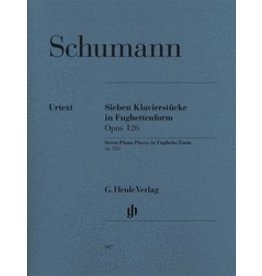
Bach's music played an important role in the Schumann house and Robert occasionally turned to baroque forms. However, he wanted these fugues to be understood as “character pieces, just in a stricter form.
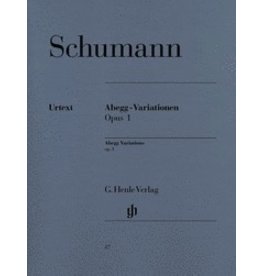
Who was “Pauline, Countess of Abegg,” the dedicatee of the first edition? Nowadays it is known that the matter revolves around a romantic mystification of the name of Meta Abegg, a friend from Schumann's
By Robert Schumann
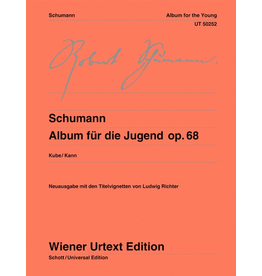
Schumann's important and beloved opus includes two sets of pieces - for beginners and for more advanced, originally structured in purely progressive manner. The Album for the Young is the perfect step into performance playing, after tec
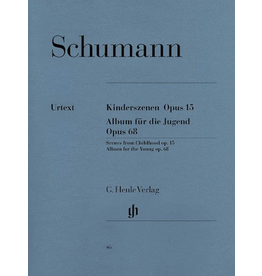
Combining these two Schumann bestsellers seemed very natural: both of the titles not only reflect their inner association but the technical demands on the pianist are for once not so great (see the level
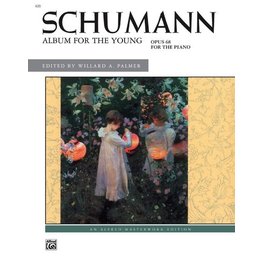
By Robert Schumann / ed. Willard A. Palmer
Numerous selections from Schumann's Album for the Young have long been favorites of intermediate students, and few collections fail to include the "Soldier's March," the "Happy Farmer" or the "Wild Horseman." Th
Initially only conceived as a birthday album for his daughter Marie, Schumann's Pieces for Piano op. 68 received tremendous acclaim throughout the world. Is there a piano student who has not played part
The high opus number suggests that it is a late work, yet in reality the work comprises twenty single movements which were composed 10 to 15 years before publication. This means that they were written aro
“Everywhere only confused combinations of figures, dissonances, passages – in short, for us torture.” – Schumann certainly did not deserve this contemporary slating. He only published the opening movement
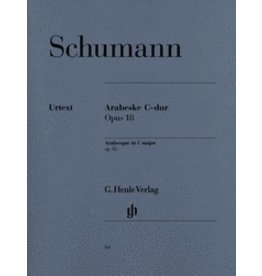
Composed in Vienna in 1838 along with several other shorter pieces, Schumann's Arabesque has found a permanent place in the general piano repertoire. It may owe its lightness and grace to Schumann's urge
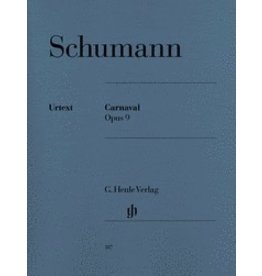
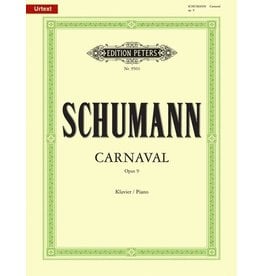
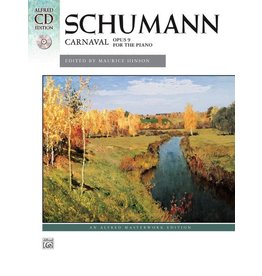
Schumann's turbulent love-affair with the barely eighteen-year-old Ernestine von Fricken, though strong enough to lead to a secret engagement, lasted only a few months. Nevertheless, it managed to give ri
Carnaval is characteristic of Schumann's highly individual youthful romanticism and requires musical maturity for performance. Written for advanced pianists, it is a series of glimpses enveloped in the atmosphere of
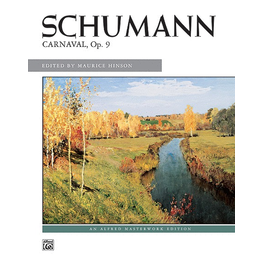
By Robert Schumann / ed. Maurice Hinson
Carnaval is characteristic of Schumann's highly individual youthful romanticism and requires musical maturity for performance. Written for advanced pianists, it is a series of glimpses enveloped in the atmosphere of
Like many other nineteenth-century musicians, Robert Schumann wanted to settle down in the musical capital of Vienna. Though these plans came to naught, his stay in Vienna in 1839 gave rise to an entire s
Composer: Robert SchumannEditor: Wolfgang Boetticher
In Schumann's middle years there was a longer period in which he favored larger groups of instruments. Although he composed a few single pieces for piano, they remained unpublished at first. It was on
For the first time since Clara Schumann's Complete Edition of 1879-93, all of the works for piano solo are appearing as one editorial project. Includes extensive commentary, alternate versions, and more.
On the 200th anniversary of Robert Schumann's birth, an ambitious project is coming to a close: For the first time since Clara Schumann's Complete Edition of 1879–93, all of the works for piano solo are a
On the 200th anniversary of Robert Schumann's birth, an ambitious project is coming to a close: For the first time since Clara Schumann's Complete Edition of 1879–93, all of the works for piano solo are a
On the 200th anniversary of Robert Schumann's birth, an ambitious project is coming to a close: For the first time since Clara Schumann's Complete Edition of 1879–93, all of the works for piano solo are a
On the 200th anniversary of Robert Schumann's birth, an ambitious project is coming to a close: For the first time since Clara Schumann's Complete Edition of 1879–93, all of the works for piano solo are a
On the 200th anniversary of Robert Schumann's birth, an ambitious project is coming to a close: For the first time since Clara Schumann's Complete Edition of 1879–93, all of the works for piano solo are a
On the 200th anniversary of Robert Schumann's birth, an ambitious project is coming to a close: For the first time since Clara Schumann's Complete Edition of 1879–93, all of the works for piano solo are a
On the 200th anniversary of Robert Schumann's birth, an ambitious project is coming to a close: For the first time since Clara Schumann's Complete Edition of 1879–93, all of the works for piano solo are a
On the 200th anniversary of Robert Schumann's birth, an ambitious project is coming to a close: For the first time since Clara Schumann's Complete Edition of 1879–93, all of the works for piano solo are a